 Pocket
Climbing Grades Explained: V-Scale, YDS and Font Conversion Charts
V4, 6B+, 5.10c, 7a: climbing grades look like a secret code until someone explains them. This guide covers the grading systems you'll actually meet in the US and Europe, for bouldering and for roped climbing, with conversion charts and a realistic picture of what beginners climb.
Quick answer: Bouldering is graded on the V-scale in the US (VB/V0 to V17) or the Font scale in Europe (4 to 9A). Roped routes are graded with the Yosemite Decimal System (YDS) in the US (5.0 to 5.15d) or French grades in Europe (4 to 9c). Higher always means harder. Most beginners start around VB–V1 and 5.6–5.8.
- How climbing grades work
- Class 1 to class 5: what "class 5 climbing" means
- Bouldering grades: the V-scale
- Bouldering grades conversion chart (V-scale vs Font)
- Route grades: YDS and French
- Route grades conversion chart
- What do 5.13 and 5.15d mean?
- What grade should a beginner climb?
- Why grades feel different everywhere
- FAQ
How climbing grades work
A grade is a consensus opinion of how hard a climb is. The first person to climb it suggests a grade; later climbers agree or argue it up or down. Over time, most climbs settle on a grade that feels fair to most people.
Different styles have different scales because they test different things. A boulder problem is a few hard moves close to the ground, so its grade rates the hardest moves. A roped route is long, so its grade reflects the hardest section plus how sustained the climb is. That's why bouldering and route grades use separate systems, and why the conversion between them is only a rough guide.
Class 1 to class 5: what "class 5 climbing" means
In the US, the Yosemite Decimal System (YDS) starts by sorting terrain into five classes:
| Class | What it means | Rope? |
|---|---|---|
| Class 1 | Walking on a trail | No |
| Class 2 | Easy scrambling; you may use your hands for balance | No |
| Class 3 | Scrambling where you use your hands to climb; a fall could hurt | Usually not |
| Class 4 | Exposed scrambling or easy climbing where a fall could be serious | Often |
| Class 5 | Technical rock climbing; a fall could be fatal without protection | Yes, for most people |
Everything climbers call a "route" is class 5, so the class number becomes the "5." in front of every route grade. The number after the dot rates how hard that class 5 climbing is: 5.6 is easy, 5.10 is solid intermediate, 5.13 is elite, and the hardest routes in the world are around 5.15d. (If you searched "class 5 climbing" looking for a specific gym, this is also where its name comes from.)
Bouldering grades: the V-scale
The V-scale (from "Vermin," the nickname of its creator, and first used at Hueco Tanks, Texas) is the standard bouldering scale in North America. It's open-ended:
- VB or V0: beginner. Many gyms add VB ("V-basic") or "V-easy" below V0.
- V1–V3: beginner to improving. Most regular gym climbers reach this range in their first months.
- V4–V6: intermediate. Usually takes consistent climbing and some training.
- V7–V10: advanced. Years of dedicated climbing for most people.
- V11 and up: elite. The hardest problems in the world are currently graded around V17.
Gyms often show grades as ranges (V0–V2, V3–V5) or as color circuits, because the exact number matters less than the rough level.
Bouldering grades conversion chart: V-scale vs Font
Europe and many international gyms use the Font (Fontainebleau) scale, named after the famous bouldering forest near Paris. Font grades use numbers with letters and plus signs (6A, 6A+, 6B…). They convert roughly like this:
| V-scale (US) | Font (Europe) | Level |
|---|---|---|
| VB | 3 | Beginner |
| V0 | 4 | |
| V1 | 5 | Improving |
| V2 | 5+ | |
| V3 | 6A / 6A+ | |
| V4 | 6B / 6B+ | Intermediate |
| V5 | 6C / 6C+ | |
| V6 | 7A | |
| V7 | 7A+ | Advanced |
| V8 | 7B / 7B+ | |
| V9 | 7C | |
| V10 | 7C+ | |
| V11 | 8A | Elite |
| V12 | 8A+ | |
| V13 | 8B | |
| V14 | 8B+ | |
| V15 | 8C | |
| V16 | 8C+ | |
| V17 | 9A |
The two scales don't line up perfectly, especially at the lower end, so you'll see slightly different charts online. Use this as a rough guide, not a rule.
Route grades: YDS and French
For roped climbing (top rope, sport and trad), US climbers use the YDS: 5.0 up to 5.9, then 5.10 to 5.15 with letters a, b, c, d added from 5.10 upward (5.10a is easier than 5.10d). Some gyms simplify the letters to plus and minus (5.10-, 5.10, 5.10+).
Most of Europe uses French sport grades: numbers from about 3 to 9, letters a, b and c, and an optional plus (6a, 6a+, 6b…). Lowercase letters mean a route; uppercase means a Font boulder grade. That small detail confuses a lot of people.
Trad climbs in the UK add a separate adjective grade for seriousness (like E1 or HVS), but if you're climbing in a US gym you won't need it.
Route grades conversion chart: YDS vs French
| YDS (US) | French | YDS (US) | French |
|---|---|---|---|
| 5.6 | 4 | 5.12a | 7a+ / 7b |
| 5.7 | 4+ / 5a | 5.12b | 7b+ |
| 5.8 | 5b | 5.12c | 7c |
| 5.9 | 5c | 5.12d | 7c+ |
| 5.10a | 6a | 5.13a | 8a |
| 5.10b | 6a+ | 5.13b | 8a+ |
| 5.10c | 6b | 5.13c | 8b |
| 5.10d | 6b+ | 5.13d | 8b+ |
| 5.11a | 6c | 5.14a | 8c |
| 5.11b | 6c+ | 5.14b | 8c+ |
| 5.11c | 7a | 5.14c | 9a |
| 5.11d | 7a+ | 5.14d | 9a+ |
Above 5.14d, the hardest sport routes in the world sit around 5.15c–5.15d (French 9b+ to 9c). Again, conversions are approximate and different sources disagree by a step.
Can you convert bouldering grades to route grades?
Only very roughly. A common rule of thumb is that a boulder grade feels like a short, intense version of a much harder route grade. For example, climbers who boulder V4–V5 often climb routes somewhere around 5.11–5.12, but endurance, fear and rope experience change that a lot. Treat the two as separate ladders.
What do 5.13 and 5.15d mean?
5.13 and 5.15d are YDS route grades near the top of the scale. The "5." means class 5 technical climbing, the number after the dot is the difficulty, and from 5.10 up a letter from a (easiest) to d (hardest) splits each number into four steps. 5.13 is elite-amateur level; 5.15d is the hardest sport grade anyone has climbed.
The letter subgrades: a, b, c, d
Below 5.10, grades are just numbers (5.7, 5.8, 5.9). From 5.10 upward, each number is split into four letters, so the ladder goes 5.12d, then 5.13a, 5.13b, 5.13c, 5.13d, then 5.14a. That means "5.13 d" (usually written 5.13d) is the hardest step of 5.13, just below 5.14a. Some gyms replace letters with a minus or plus, where 5.13- is roughly 5.13a/b and 5.13+ is roughly 5.13c/d.
| YDS (US) | French | Where it sits |
|---|---|---|
| 5.13a | 8a | Entry to elite; a long-term goal for many dedicated climbers |
| 5.13b | 8a+ | Elite amateur, strong competition climbers |
| 5.13c | 8b | |
| 5.13d | 8b+ | |
| 5.14a–5.14d | 8c–9a+ | Professional and near-professional level |
| 5.15a–5.15c | 9a+–9b+ | A small group of the world's best sport climbers |
| 5.15d | 9c | The hardest established sport grade |
5.13 climbing: elite-amateur level
5.13 is where climbing grades move from "very good" to "elite." Most climbers who reach it have climbed and trained consistently for years, and plenty of lifelong climbers never do. It's also the grade of some famous big walls: Freerider on El Capitan is usually graded 5.13a, which is the route Alex Honnold climbed without a rope in 2017 (more on that in our free climbing guide).
5.15d climbs: the hardest routes in the world
As of early 2026, three sport routes carry a 5.15d (9c) grade, according to Gripped's 2026 review of the hardest routes:
- Silence, Flatanger, Norway: first climbed by Adam Ondra on September 3, 2017, and the world's first 9c.
- DNA, Verdon Gorge, France: first climbed by Seb Bouin in spring 2022.
- B.I.G., Flatanger, Norway: first climbed by Jakob Schubert in September 2023.
Grades this hard are proposals by the first climber until others repeat the route and agree, so they can still change. There's no direct V-scale equivalent for a route grade, but for perspective, the bouldering counterpart at the very top of the scale is V17 (Font 9A), the hardest grade in our bouldering chart above.
What grade should a beginner climb?
- First sessions: VB–V1 bouldering, 5.6–5.8 on top rope.
- First 6–12 months of regular climbing: many people reach V2–V4 and 5.10–5.11. Some move faster, some slower; both are normal.
- Progress tip: spend most of your session one or two grades below your max to practice technique, and only a few attempts at your limit.
If you're just starting, our bouldering tips for beginners and the 12-week beginner training plan are the fastest way up the grades. New to the whole thing? Start with what bouldering actually is.
Why grades feel different everywhere
- Grades are opinions. Setters grade by consensus, and every gym and crag has its own tradition: some are "soft," some "sandbagged."
- Style matters. A V4 on a steep overhang and a V4 on a vertical crimpy wall test different skills. You'll find some styles easier than others.
- Body size matters. Reach, finger size and weight change how hard specific moves feel.
- Indoor vs outdoor. Real rock has hidden footholds and unmarked holds. Most people climb one or two grades lower outside at first.
The healthiest way to use grades: compare yourself with yourself, not with the person next to you.
Safety note: Chasing grades too fast is a common cause of finger injuries. Build up gradually, warm up properly before hard attempts (here's a 15-minute climbing warm-up), and stop if you feel sharp pain or a pop in a finger.
Practice hold types between sessions
Higher grades mean smaller crimps, worse slopers and harder pinches. Climbing is the best way to learn them. On rest days, a hand-held block like PocketCrag lets you practice those grip positions at a desk or on the couch: 8 bolt-on holds, 30 challenges in 4 levels from "Warm-up" to "Projects." It isn't a hangboard or a max-strength tool, just a playful way to keep your fingers busy. Disclosure: PocketCrag is our product.
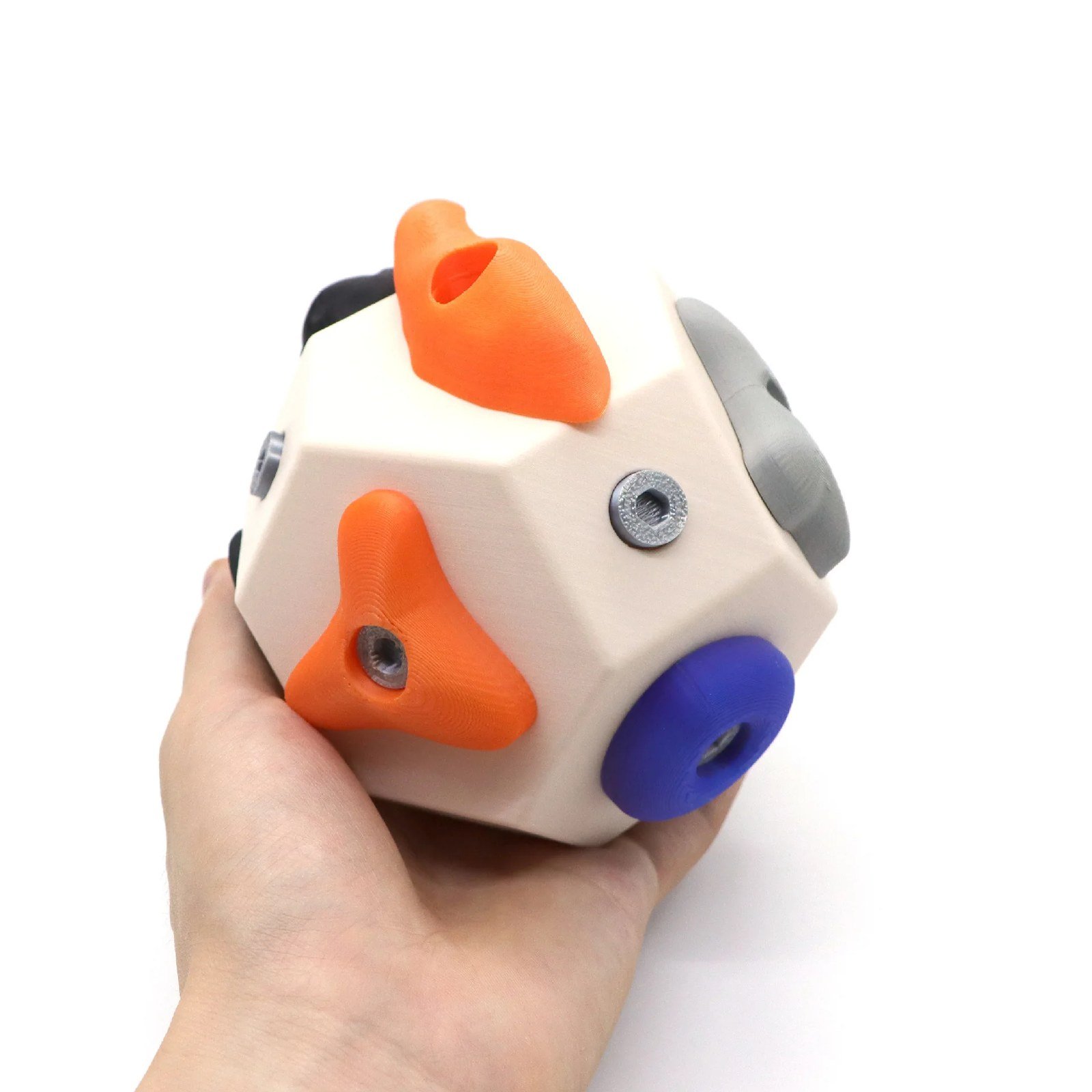
30 challenges from Warm-up to Projects
PocketCrag is a hand-held climbing block with crimps, pinches, slopers and pockets. $44.99, free US shipping and a 30-day guarantee.
Shop PocketCrag →If you're still on your first few climbs, our rock climbing for beginners guide covers what to expect at the gym, and our climbing techniques guide explains the moves that unlock harder grades.
Climbing grades FAQ
How do climbing grades work?
A climbing grade is a consensus rating of how hard a climb is for its style. Bouldering uses the V-scale in the US (VB/V0 up to V17) or the Font scale (4 up to 9A). Roped routes use the Yosemite Decimal System in the US (5.0 to 5.15d) or French sport grades in Europe (4 to 9c). Higher numbers mean harder climbs.
What does class 5 climbing mean?
In the Yosemite Decimal System, terrain is split into classes 1 to 5. Class 1 is walking, class 2 is easy scrambling, class 3 is scrambling with hands, class 4 is exposed scrambling where a fall could be serious, and class 5 is technical rock climbing where most people use a rope. The number after the dot (5.6, 5.10a, 5.12c) rates how hard the class 5 climbing is.
What is V0 in bouldering?
V0 is one of the easiest bouldering grades on the V-scale, roughly Font 4. Many gyms also have VB (V-basic or V-easy) below it. Most beginners start on VB to V1 problems.
How do V grades convert to Font grades?
Roughly: V0 = 4, V1 = 5, V2 = 5+, V3 = 6A/6A+, V4 = 6B/6B+, V5 = 6C/6C+, V6 = 7A, V7 = 7A+, V8 = 7B/7B+, V9 = 7C, V10 = 7C+, V11 = 8A, V12 = 8A+, V13 = 8B, V14 = 8B+, V15 = 8C, V16 = 8C+, V17 = 9A. Conversions are approximate because the scales don't line up exactly.
What does 5.13d mean in climbing?
5.13d is a Yosemite Decimal System route grade, roughly French 8b+. From 5.10 upward, each number is split into four letter subgrades, a to d, so 5.13d is the hardest step of 5.13, just below 5.14a. 5.13 is considered elite-amateur level, reached by climbers with years of consistent climbing and training.
What is the hardest climbing grade in the world?
For sport routes, the hardest established grade is 5.15d, or French 9c. As of early 2026, three routes carry it: Silence in Norway, first climbed by Adam Ondra in 2017, DNA in France by Seb Bouin in 2022, and B.I.G. in Norway by Jakob Schubert in 2023. For bouldering, the top grade is V17, or Font 9A.
What is a good climbing grade for a beginner?
Most beginners start bouldering on VB to V1 and top-roping on 5.6 to 5.8. Many people climb V2 to V3 or 5.10 within their first year of regular climbing. Grades vary a lot between gyms, so compare yourself with your own progress rather than with other people.
Why do grades feel different at different gyms?
Grades are opinions agreed by setters and climbers, not measurements. Wall angle, hold style, your height and your strengths all change how hard a climb feels, and each gym and crag has its own grading tradition. Outdoor grades often feel harder than the same number indoors.