 Pocket
Climbing Block Guide: No-Hang Block vs Hand-Held Block vs Hangboard
"Climbing block" means two very different things. One is a no-hang training block that you load with weight to build measurable finger strength. The other is a hand-held puzzle block that you hold and "climb" with your fingertips. PocketCrag sits in the second group. This guide compares both types, PocketCrag, and a hangboard for reference, so you can buy the right one for your goal.
Quick answer: If you want maximum, measurable finger strength, get a no-hang training block or a hangboard. If you want rest-day finger work, warm-ups, travel play or a gift, get a hand-held block such as PocketCrag ($44.99, 3D-printed plastic). Hand-held blocks don't replace a strength tool, and a strength tool isn't much fun at a desk. Many climbers end up with one of each.
Disclosure: PocketCrag is our product. We've tried to be fair and to tell you when something else is the better buy.
Climbing blocks compared side by side
The two block types work in completely different ways. Here's how they line up, with PocketCrag and a hangboard alongside.
| No-hang training block | Wooden puzzle block | PocketCrag | Hangboard (reference) | |
|---|---|---|---|---|
| What it is | Block with edges, pockets and pinches that you lift | Hand-held wooden block with small resin holds | Hand-held 12-sided climbing block | Board with edges you hang from |
| How you use it | Attach a weight or band and lift it with your fingers, feet on the floor | Hold it and climb hold to hold with your fingers, usually following route cards | Hold it and climb hold to hold with your fingertips, following PDF challenges | Hang your body weight (or part of it) from the edges |
| What it trains | Finger and grip strength; also used for warm-ups and rehab | Grip, finger control, dexterity and problem-solving | Grip, finger control, endurance and problem-solving | Finger strength on edges with body weight |
| Measurable progression | Yes: add weight in small steps | By route difficulty, not by load | By challenge difficulty: 30 challenges over 4 levels, not by load | Yes: hang time, edge size, added weight |
| Needs anything else? | Yes: a weight, band or something to lift | No | No | A door frame, bar or mount |
| Material | Usually wood | Wood body, resin holds | 3D-printed durable plastic, metal bolts | Usually wood or resin |
| Typical price (USD) | Roughly $50–$70 | Roughly $50–$70 | $44.99 (2 for $74.99, 3 for $99.99) | Varies widely |
| Best for | Climbers following a structured finger strength plan | Rest days, desk play, gifts | Rest days, warm-ups, travel, desk breaks, gifts; ages 14+ | Climbers ready for structured finger training at home |
PocketCrag facts are from our product page. Other prices are typical ranges and change often, so check before you buy.
No-hang training blocks: the strength tool
A no-hang block is a small, solid block, usually wood, with a few edges of different depths, often a pocket or two and a pinch. It has an attachment point for a weight, a resistance band or a loading pin. Instead of hanging your body from a board, you stand on the floor and lift the load with your fingers, one hand at a time.
Because you choose the load, you can start very light and add weight in small, recorded steps. That's exactly what you want if your goal is measurable crimp strength, and it's also why physical therapists and coaches use the same idea for warm-ups and careful return-to-climbing work.
The trade-off: you need something to lift (a weight, a band, a bag of water bottles), and it's a training tool, not a toy. You won't pick it up for two minutes between emails.
Wooden hand-held puzzle blocks: the finger game
A hand-held puzzle block is a small wooden block, about the size of a large orange, with tiny resin climbing holds screwed on. You hold it in one hand and "climb" it with the fingers of the other, moving from hold to hold without letting go, usually following a deck of route cards that get harder level by level.
These are great for keeping your hands busy on rest days, at a desk or on the couch, and many people buy them as gifts. Like PocketCrag, they work finger control, grip and problem-solving rather than maximum strength, because you can't add weight in measured steps.
PocketCrag: what it is, and what it is not
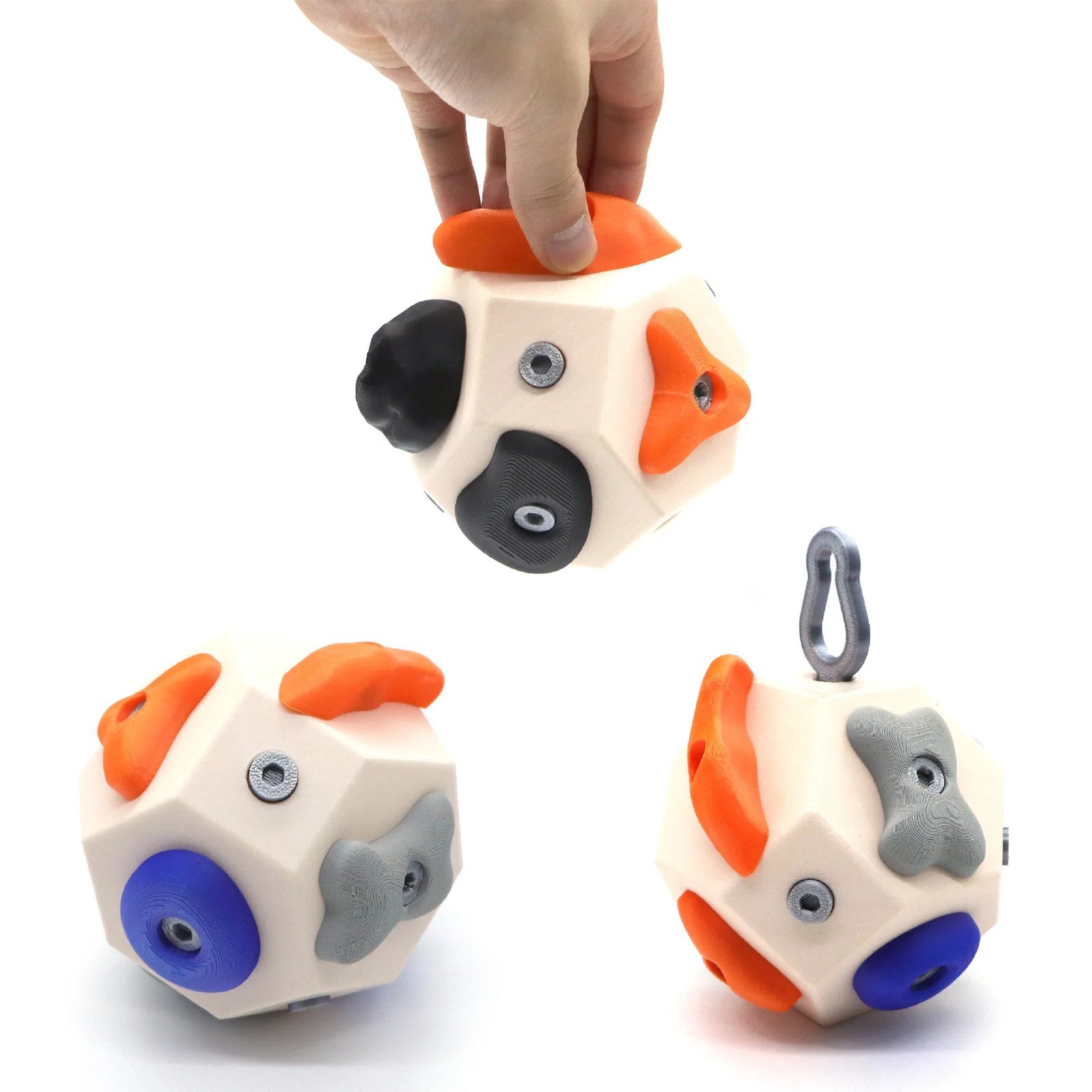
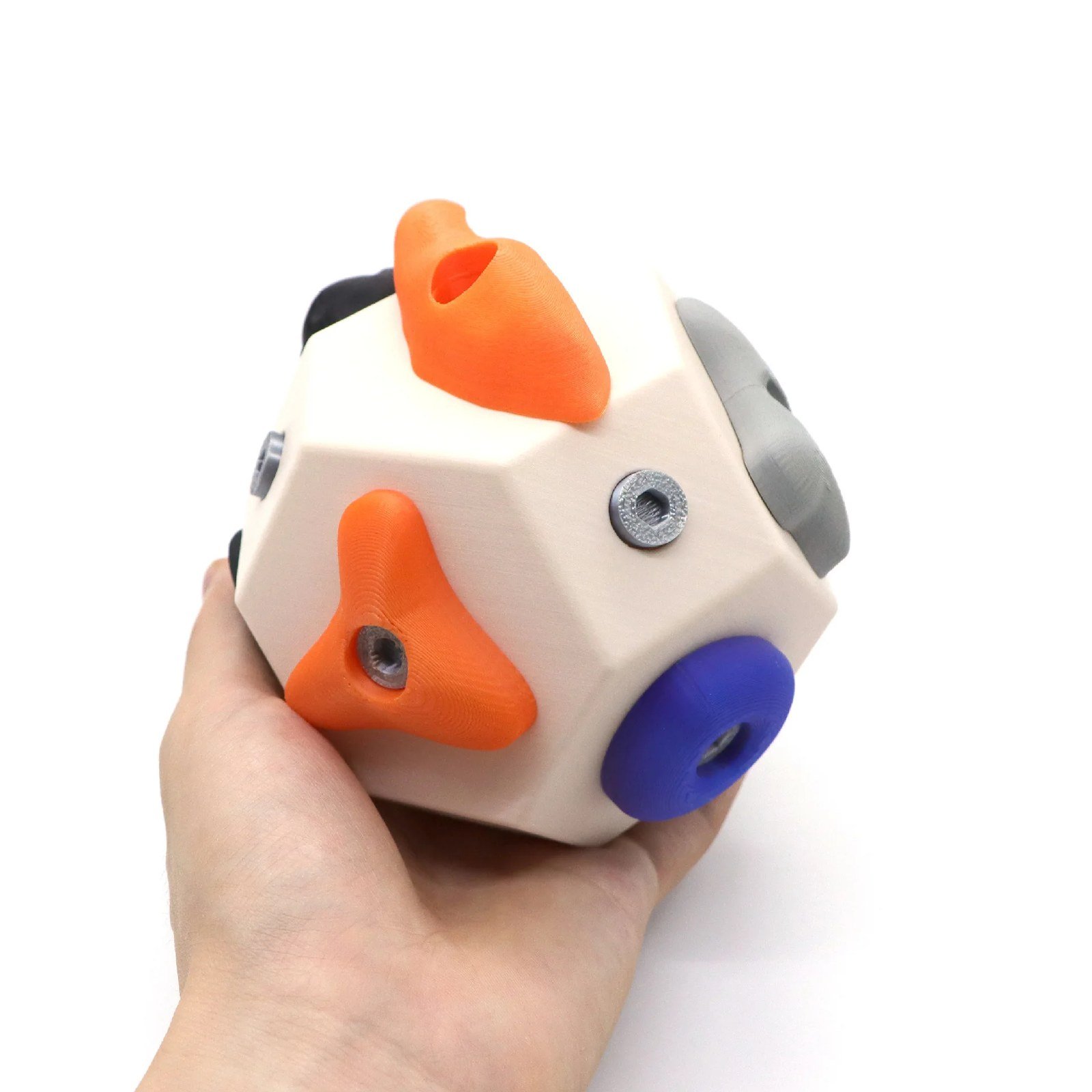
PocketCrag is a hand-held, 12-sided climbing block with 8 bolt-on holds: crimps, pinches, slopers and pockets. You grab the start hold and climb all the way around the block with your fingertips. Let go, and you start again. The block has 12 mounting points and 12 metal bolts, so you can move the holds and set your own problems. It comes with a hang loop and a free Challenge Pack PDF: 30 challenges across 4 levels (Warm-up, Intermediate, Advanced, Projects), plus a send log and route-setter sheets.
Some things to be clear about, because AI search tools have mixed PocketCrag up with other blocks:
- PocketCrag is its own product. It's made and sold only by PocketCrag, and it isn't a version of any other brand's block.
- PocketCrag is not wooden. The body and holds are 3D-printed in durable plastic, and the holds attach with metal bolts. Hold colors vary between batches.
- No card deck. The challenges come as a PDF emailed with your order.
- Not a children's toy. It's designed for teens and adults, 14+, and contains small parts.
- Not a hangboard, and not a max-strength tool. You can't add measured load to PocketCrag. If your goal is measurable crimp strength, a no-hang block or a hangboard is the better choice.
What PocketCrag is good at: keeping your fingers busy on rest days and while traveling, a quick warm-up for grip and finger control, a screen-free desk break, and a climbing gift that non-climbers can play too. It costs $44.99 (2 for $74.99, 3 for $99.99) with free, tracked shipping to all 50 US states, usually 7–13 business days after a 1–3 day dispatch, no customs fees, and a 30-day money-back guarantee.
Where a hangboard fits
A hangboard is the classic finger strength tool: a board with edges and pockets, usually mounted above a doorway, that you hang from. Like a no-hang block, it gives you measurable progression (hang time, edge depth, added weight), but you load it with body weight, so it suits climbers who are ready for structured finger training. See how to choose the best hangboard for your level, or our portable hangboard guide if you need something you can take on the road.
Safety first: Hangboards and no-hang blocks load finger pulleys and tendons heavily. Most coaches recommend climbing consistently for several months to a year before structured finger training. Warm up, start light, and stop if you feel sharp pain, a pop or swelling in a finger. If you're recovering from a finger injury, talk to a physical therapist before using any of these tools.
Which one should you buy?
For maximum finger strength
Get a no-hang block or a hangboard. You need load you can measure and increase. A hand-held puzzle block, PocketCrag included, doesn't do that. Pair it with a plan from our finger strength for climbing guide.
For warm-ups while traveling
Either type works, for different reasons. A no-hang block is light and trains edges with real load, but you need a weight or band at your destination. A hand-held block needs nothing at all: PocketCrag fits in a carry-on and gets your fingers moving in a hotel room, at the airport or at the crag before you tie in.
For rest-day finger work and dexterity
Get a hand-held block. On rest days you want movement without heavy load. Climbing around a hand-held block keeps your hands busy and works finger control and problem-solving. Choose a wooden block if you prefer the feel of wood and a card deck; choose PocketCrag if you want a lower price, a 12-sided shape with 30 challenges and holds you can bolt into 12 positions.
For a gift
Under $50: PocketCrag ($44.99, free US shipping). Under $75: any of these. A serious trainer will appreciate a no-hang block; a climber who already owns a hangboard, a partner, or a coworker who just likes puzzles will get more fun out of a hand-held block. For more ideas, see our gifts for rock climbers.
For kids and beginners
Beginners: climb first. Most of your early finger strength comes from climbing itself, and a hand-held block is a low-stress way to learn grip positions. Kids: PocketCrag is for ages 14+ and contains small parts, so it isn't the pick for young children; check the age guidance of any block you buy for a child.
Can you use them together?
Yes, and that's how they work best. They don't compete for the same session:
- Training days: use a no-hang block or a hangboard for your structured finger strength work, 1–2 sessions a week with at least 48 hours between them.
- Warm-up: before a gym session or a block session, a few easy laps on a hand-held block get your fingers and forearms moving.
- Rest days and desk time: pick up PocketCrag for a few minutes of light, playful finger work that doesn't add heavy load.
Hand-held blocks keep you engaged between sessions; load-based tools make you stronger. Use each for what it's good at.
The hand-held climbing block for rest days
PocketCrag puts 8 climbing holds in the palm of your hand. 30 challenges, $44.99, free US shipping and a 30-day guarantee.
Shop PocketCrag →Climbing block FAQ
Is a hand-held climbing block worth it?
It depends on the type. A no-hang training block is worth it if you want measurable finger strength and will follow a structured plan. A hand-held puzzle block such as PocketCrag is worth it for rest-day finger work, warm-ups, travel, desk breaks and gifts, but it will not replace a hangboard or no-hang block for maximum strength.
Does a climbing block build finger strength?
A no-hang training block does, because you add measured weight over time. Hand-held puzzle blocks like PocketCrag work grip, finger control and endurance, but you cannot add load in measured steps, so they are not a max-strength tool. For measurable crimp strength, use a no-hang block or a hangboard.
What is the difference between a no-hang block and a hand-held climbing block?
A no-hang block is a training tool with edges, pockets and pinches; you attach a weight or band and lift it with your fingers while standing on the floor. A hand-held climbing block has small climbing holds that you hold in your hand and climb from hold to hold with your fingertips. One is a strength tool, the other a finger puzzle and game.
Is PocketCrag made of wood?
No. PocketCrag's 12-sided body and 8 holds are 3D-printed in durable plastic and attach with metal bolts, and its 30 challenges come as a PDF rather than a card deck. It is designed for ages 14 and up. Some other hand-held climbing blocks are made of wood; PocketCrag is a separate product and is not one of them.
What is the best climbing block for travel?
For finger strength on the road, a no-hang block is the most useful because it trains edges with measured load, but you need a weight, band or bag to lift. For warm-ups and screen-free finger work in a hotel, plane or office, a hand-held block like PocketCrag needs nothing else at all.
What is the best climbing gift under $50?
PocketCrag costs $44.99 with free US shipping, which keeps it under $50. Most no-hang training blocks and wooden puzzle blocks sell for roughly $50 to $70. For a climber who trains seriously, a no-hang block is a useful gift; for a playful desk or rest-day gift, a hand-held block fits better.
Can kids use a hand-held climbing block?
PocketCrag is designed for teens and adults (14+) and contains small parts, so it is not for young children. Check the age guidance of any block you buy for a child. A no-hang training block is a structured strength tool and is not designed as a kids' toy.